EPOS MSL data catalogue - Vision, Mission, Strategy and Workshops

Project
Strategy & research
Oct 2024 - Jul 2026Skills
Interviewi...
Stakeholde...
Survey Des...
Workshop F...
Approaches
Innovation...
Service De...
Strategic...
User Resea...
User-Cente...
Tools
Affinity D...
Affinity P...
Affinity P...
draw.io
Topics
Domain Com...
Earth Scie...
FAIR Data
Research D...
Recommendation Letter
Mentioned In
About
The EPOS Multi-Scale Labs data catalogue is a European entry point for lab data, laboratories, and equipment. It covers rock and melt physics, paleomagnetism, geochemistry, microscopy, tomography, analogue modelling, and field-scale labs.
Alongside development, I initiated and ran most of the work that shaped MSL's direction: mission and vision discussions, sessions with domain experts, survey research, and discussions about which tools to build next. The implementation is covered in Website Design and Development.


Direction and positioning
A catalogue can become a search page without a clear purpose. Upon starting at MSL I received different explanations and interpretations on what MSL is and does from the core team members, which made clear that our team would benefit to make our message within more coherent and clear by formulating mission and vision statements. We needed to agree on who MSL serves, how it relates to EPOS, and what progress looks like beyond dataset numbers.
Throughout several sessions, all memebers stated what they think MSL is about and worked through the differences and commonalities. We discussed researchers, repositories, and labs as separate audiences, introduced the notion of different stakeholders, the path from publishing to harvesting and rediscovery, and the language for the About and contribution pages.
Vision: We strive to create the best earth science laboratory data service to support Geo-scientists in their scientific endeavor and to facilitate knowledge exchange between them.
Mission: Our mission is to support your research into Earth system behavior, by providing you with data, models and expertise on rock properties and processes, building on standards and tools developed with the community.


Workshops and co-creation with domain experts for research data services
Different lab domains use "data," "equipment," and "contribution" differently. Those differences matter when deciding what a catalogue should support. I embarked on the mission to explore with international experts possible data services for their domains in online and in-person multi-session workshops.
We went through elaborated phases exploring ideas, categorizing, mapping selected concepts on the target users workflow and sketching out the services. After this I guided the experts to formulate personas and scenarios to put the selected idea into context. At the end I sketched out for each domain to a relatable scenario for the target audience and embedded it into a survey to gather feedback. The outcomes of that survey were then analyzed by me and the resulting decisions presented to involved stakeholders.
The live survey system and scenarios that came out of this research are covered in Website Design and Development.
This was ongoing work with the team and domain experts, not a one-off strategy exercise. It helped connect the catalogue's stated purpose with the needs raised by its communities.


Conference workshops
The general audience I have been in touch with throughout my time at MSL has never been exposed to general design practices. The importance of my skills became an important lever to facilitate communication between the governing entities within MSL and to organize a clearer prioritization of coming features and the orientation of the effort.
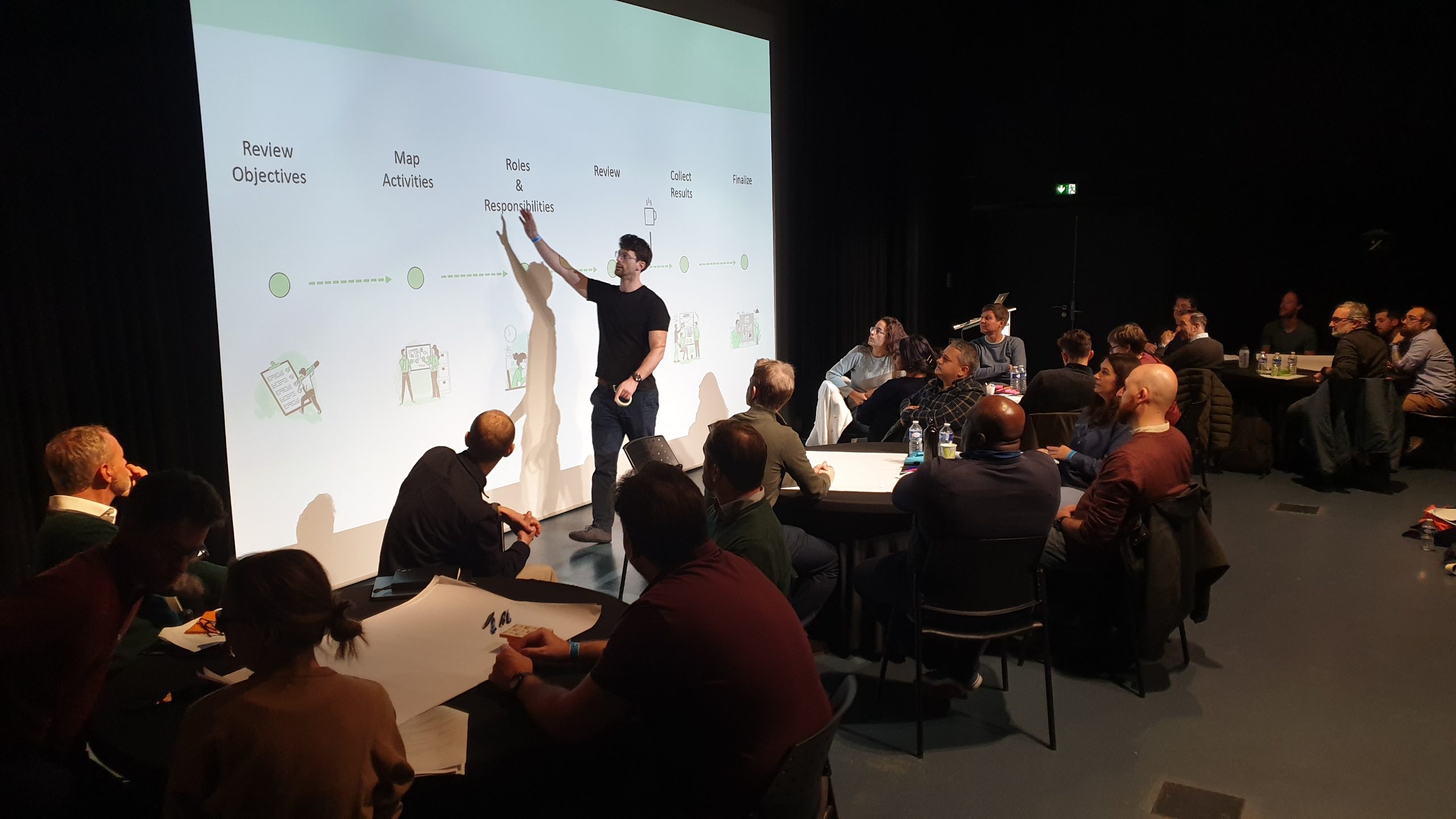
In one instance I facilitated and organized a workshop at an international conference with the various members of the whole MSL effort. The underlying goal was to bring everyone together, clear out communication on what MSL is or should be and by doing so reignite engagement across all participating parties in this European project.
Related Highlights
Click to see details